Showing posts with label writing research. Show all posts

Friday, 7 July 2017

Ask Annie...about Regency costume.

On the first Friday of each month, Novelista Annie Burrows will be drawing a question out of the jar where we've been putting all the questions about the writing process posed by readers.

This month, the question she chose to answer is:


"Your heroines wear lovely gowns. Do you make them up, or are they based on actual Regency clothes?"

OK, well, first of all, if you’ve read any of my books, you will know that I don’t, as a rule, put in a lot of detail about this sort of thing.  This is because I think it can detract from the story, and the action going forward if you keep breaking off to spend whole paragraphs describing a room, or an outfit.  I tend to use broad brushstrokes to suggest the era, or the scene, or even the clothes, and rely on the reader to fill in the gaps with their own imagination.  So that I can concentrate on the emotional inner life of my character, and the action going forward.

BUT…part of being able to create vivid, believable Regency characters comes from being historically accurate.  I have to know all about the background even if all I’m going to do is sketch it in briefly, or it won’t ring true, and will be a far less enjoyable read.

This is particularly true of clothing.  I have to know what a Regency lady would wear, so that love scenes can play out convincingly as the hero removes her garments one by one.  I need to know what type of corset she might wear, how her stockings were held up, and whether or not she wore drawers.  Not only will this place her firmly within the historical era, but it will also say something about her social status, and her personality, too.  Silk stockings, rather than cotton, for example, or a gown that laces up at the back, rather than the front will tell the informed reader (and most readers of Regency are very knowledgeable about the customs of the age) a lot about my heroine without me having to take another couple of sentences explaining whether she is upper or lower class, wealthy or poor.

I also sometimes zoom in on an outfit a heroine is wearing to help show how she is feeling.  “The Captain’s Christmas Bride” for example, opens with the heroine’s friend struggling to do up the laces of her gown.  A short cut to telling the reader she has body issues.

In the opening section of “The Debutante’s Daring Proposal”, the heroine is conscious of her frayed gloves and her muddy boots when the hero strides onto the page looking all expensive and elegant, to emphasise the differences in their social and financial status.

As on all other topics of Regency life, I have a few favourite books that I frequently consult to give me inspiration, or to help me describe an outfit convincingly.

Another thing I’ve done is to purchase a reconstruction of a Regency costume, to see what it would feel like to move around in long skirts.  I wasn’t surprised that my movements felt a bit restricted compared to the normal jeans and t shirt which are my usual everyday wear.  Long skirts are not very practical.  By the end of the day the hem was filthy.  It seemed to suck up dirt like a hoover.  Being cotton, though, it washed very well, and came up good as new.  However, it made me realise that keeping clothes clean would indeed need the services of a maid to do the laundry and ironing.  How on earth would you have been able to keep your clothes clean without the help of servants in an age without washing machines?  Wearing light colours had to have been a symbol of status.  Lower class women would surely have chosen darker colours that didn’t need laundering every day, or changing every day at least.  So all those debutantes in their pristine white muslin gowns were probably making more of a statement than just about their youth and virginity.

           One thing that did surprise me, though, was how warm the outfit was.  Everyone assumes that
wearing light muslin or cotton gowns must have meant that the women would have felt cold.  The gown I’m wearing in the picture was actually made up of two dresses.  An underdress and an overdress.  The outfit came with a full length cotton petticoat, too.  The underdress could have been worn on its own, but I chose to put on the top one as well on this day.  Once I’d put all three layers on, I was actually too warm, so had to (shock, horror!) remove the petticoat.  I didn’t buy a corset, since I was only out in Regency garb for fun, not to go on a re-enacting event where authenticity would have been more important, but I can imagine that had I been dressed in a shift, corset, petticoat, underdress and overdress, I would have jolly well needed to make use of a fan to keep me from sweating.

 A  properly brought up Regency lady would not have ventured out of doors without a bonnet and gloves, either.  (I did buy a bonnet, but went without the gloves – shockingly fast of me!)  What with all those layers, and a hat and gloves, I felt I could have survived the most inclement weather.  Or at least, I could have done with the addition of a spencer (short jacket) or pelisse (long coat)  Don’t forget that with full length skirts, you could wear pretty much what you liked underneath and nobody would have seen it.

Thick woollen stockings and boots in winter?  Probably.

So, I do study pictures of what Regency ladies wore, and I’ve spent a day wearing a reconstruction of the type of gown a Regency lady would have worn, so that I know how she would feel in it.

So that I can leave out the descriptions of gowns with a fair amount of confidence!


(I have considered buying my husband some male Regency garb, strictly for research purposes of course, but they are far more expensive than the female attire.  Especially the hats.)


Annie's latest release is "The Debutante's Daring Proposal" in which the heroine wears a variety of costumes which are rather daring, and which cause gentlemen to look at certain parts of her anatomy rather than her face when they are speaking to her.


It is available in paperback and ebook from Amazon...


Wednesday, 4 February 2015

Writing What You Know... by Annie Burrows


Continuing Novelista Annie Burrow's monthly alphabetical rambling though the writer's life.  This week, she's reached the letter K, which is for...Knowing.  (Or not)

"There are known knowns. These are things we know that we know. There are known unknowns. That is to say, there are things that we know we don't know. But there are also unknown unknowns. There are things we don't know we don't know." (Donald Rumsfeld)

When you first start writing people advise you to write what you know.  The argument goes that you cannot write a convincing story unless you know your subject inside out and upside down.  The trouble is, I wanted to write fiction set in Regency England, which is a place I have never been, and never can go to.  All my knowledge of the era comes from books.


However, when I started attempting to get a publishing deal, I felt fairly confident that I knew enough to be able to create a convincing fictional Regency world.  I've read stacks of Georgette Heyer, Jane Austen and the like.  And whatever I didn't know enough about, I could look up, right?

So I bought loads of books about every subject I thought I might need to know about - fashion, the army, the navy and biograpies of people who actually lived in the time which would hopefully give me an idea of the mindset of people living back then.

I even go round stately homes to get an extra "feel" for the era, especially ones where I can dress up in period costume, or have a ride in a carriage.

All the little details of dress, manners, and so forth, help to create a world that strikes a reader as "real".

For example, an author may set a scene by having the hero check his cravat in the mirror.  The heroine curtsies to him.  Instantly we're in an age where manners are more formal than today, and the costumes easily dateable.  The hero asks the lady to dance the waltz.  She refuses lest she be thought "fast".  We're very firmly in Regency territory.  So far, so good.

The trouble is, there are things about the Regency world that I never knew I didn't know.  I didn't know, for example - until it was mentioned on an author loop I belong to - that a girl couldn't waltz in public until she'd been granted permission, by one of the patronesses of Almack's, within those hallowed walls, to do so with an approved partner.  I'd had no idea how close I'd come to the brink of writing one of my heroines into committing such a social gaffe.

And a lot of authors fall into the same trap.  As a resident of the UK, I cringe whenever I read of Regency bucks going down to Dorsetshire to sample the local whiskey.  Or having to banish their dogs to the stables after an encounter with a skunk on the South Downs.  For me, such slips of the pen ruin my belief in the Regency world the author is trying to create.  Though I don't suppose it has any effect on readers who don't know that in Dorset the local brew would most likely be cider, and that the only way a skunk would wander onto the South Downs was if it had escaped from some local eccentric's private collection of rare species.

Which brings me back to the inimitable Donald Rumsfeld, who has been soundly mocked for warning the world about the danger of the "unknown unknowns".  As an author, I can vouch for the peril of those pesky facts that hamper us in our creative endeavours.  I have had my own heroes and heroines unwittingly do and say things that a person living in 1815 would not have done.  I have had them use the word "hello" - which was not in common use until the 1880's except on the hunting field.  I have also had them perform a twentieth century waltz, having had no idea that in the Regency era, the waltz was nothing like the rather tame dance performed today.


Only look at the way these couples are cavorting in each other's arms...

However, if I was now to describe the dance with complete accuracy, I suspect that editors and readers alike would find it hard to believe in it if my hero performed an acrobatic leap while the heroine hopped to one side.  It would strike them all as bizarre, and would ruin their belief in my Regency world just as surely as it would had they arrived at the ball in question in a porsche 911.

So - I'll probably need to disguise what I actually know, so that a reader will be convinced I do know what I'm talking about.

Donald Rumsfeld might have fared better with the world's press if he'd done the same.

Annie's next book, "A Mistress for Major Bartlett" which is part of a trilogy "The Brides of Waterloo", will be out in July 2015

Thursday, 4 December 2014

I is for...Internet by Annie Burrows


On the first Friday of the month, Novelista Annie Burrows shares snippets from her writing life.  In alphabetical order.  This month she's reached the letter I

When I first started writing, I used a small word processor which I got second hand.  I used floppy disks (which regularly got corrupted) to save my work.  And when I wanted to do any research I went to my local library.


I used to spend hours browsing around the stacks, desperately searching for that one nugget of information I needed, and getting pretty frustrated in the process.  I never did find a book that could tell me where troops used to embark during the Peninsular War, or how often injured officers got sent home - though there were half a dozen biographies of Lord Wellington.

Eventually I realized I was going to have to cut back on the time I spent doing this sort of research, and concentrate on writing the story, or I was never going to get anywhere.  So - I couldn't find out where the troops disembarked from - did I really need to put it in my story?  Couldn't my heroine just receive a letter saying that her brother/uncle/sweetheart had sailed?

I still spent a lot of time going through second-hand bookshops, hoping to find that one book which would have the specific bit of information I wanted, and in the process learning all sorts of things that might come in useful one day (and subsequently have).


The next computer I bought (again, second hand so it was practically on its last legs) had a button I could press which would connect me to the internet.  Which opened up a whole new world of research possibilities.  Whatever I wanted to know about, you could bet someone had written an article (or blog, as online articles are known - mad, eh?) about it.

And now came a whole new form of time-wasting.  Instead of getting on a bus and going into town, where I would spend hours finding out virtually nothing useful, I could now waste an entire morning finding out a whole lot more than I ever actually needed to know.   Because every article (sorry, blog) seemed to have a link to another blog about something connected to the topic, which looked absolutely fascinating.   So I may have started out wanting to find what kind of rifle a soldier would have carried in 1815, and instead found a page which told me all about the parlour games people would have played during Christmas of 1814, and then stumbled upon all the information I'd wanted to find out about troop movements in the Peninsula three books ago!

I now regularly use one site to find colourful phrases for my characters to use, another to make sure that the language I put into my character's mouths was actually in use at the time they were alive, and another when I want to describe a Regency dance.
So - internet - good for research?  Yes, in that it's easier to find out exactly what I want to know.
However, I now have to be careful that I don't just end up wandering through the stacks of knowledge available to me from my own armchair, instead of getting on with the story.

And don't get me started on facebook.  Yes, it's a great way to keep in touch with readers and friends.  But do I really need to watch that video of a dog going berserk in obedience school?  Again?


Or post a picture of myself in the style of a French impressionist?

To find out more about how Annie wastes her time, you can find her on facebook.

Her latest book, a Regency romance, is "Lord Havelock's List" and can be purchased from Amazon UK

Sunday, 25 May 2014

My WW1 Garden by Juliet Greenwood

This year, I’ve loved seeing the gardens commemorating WW1 at the Chelsea Flower show.
Having read newspaper reports from the time, and lived so long in a WW1 kitchen garden in my head, it was touching to see them in all their Chelsea glory. I loved the whistles that became fountains, and the stories of the men interned in Germany creating flower gardens, with even their own strictly-judged show.

My favourite of all was the potter’s garden.

With its cottage garden flowers and path of discarded pots, it caught a real sense of the potter having left everything to volunteer, as so many men did in the first year of the war, unable to imagine the unprecedented horrors they would soon be facing, and many never to return. It had the same atmosphere as the Lost Gardens of Heligan, that first sparked my fascination with the gardens of WW1, abandoned at the moment the intricate hierarchy of gardeners left for the front, and generations of expertise were lost forever.

But, as I learnt in my research, that was not the whole story. Many gardens were abandoned, but many new were created. Before WW1, the Edwardians had lived in a brave new world of luxurious imports and the novelty of canned foods. As imports were threatened by the dangers of new-fangled submarines, necessity sent the population at home growing once more. Land girls took over the roles of agricultural workers, and schoolchildren grew vegetables wherever they could. Like today (and in the 1970s of the BBC’s ‘The Good Life’), the expense of fresh food led to a huge upsurge in allotments and self-sufficiency.  Tips appeared in the newspapers for the best ways to preserve tomatoes and beetroot for the winter ahead, and arguments ranged over the best way to grow, and where allotments should be placed.

So much was learnt in WW1 that was taken on to the organisation that swung into place in WW2, and beyond. Some of my earliest memories are of the gardens of aunts and uncles, who had no doubt absorbed memories of the First World War from their parents, and then lived themselves through the Second World War. Their gardens were full of flowers, but there was always a vegetable garden at the back, filled with peas and beans and raspberry canes. They still preserved what they could, even though this was the 1960s and another brave new world of seemingly endless plenty.

I also remember those WW1 allotments in my own garden, which originally was a long strip, like many of the quarrymen’s gardens in this part of Wales. Amongst the thin, rocky soil, I’ve a patch that is rich from generations of vegetables being grown to supplement subsistence wages. Unlike those previous generations, I’ve the luxury of a polytunnel for extra protection against the wind, and additional warmth halfway up a mountain. There’s a very strange thing about my polytunnel. It’s the only place I can grow red poppies. I’ve tried so many times in the garden, but only the yellow Welsh ones appear. Then last year, when I was trying to find poppies to photograph for the update of my website, there they were: a little patch in amongst the rocket. It gave me tingling feeling. I’m keeping my fingers crossed they reappear this year.


So this is my WW1 garden. Not a potter’s garden, but a quarryman’s garden. With it lie the memories of those who were lost, and those at home who kept the nation and the soldiers fed, and who, like the act of faith that is the essence of all gardening, found the strength to carry on amidst so much loss, and build the world anew.


Tuesday, 13 May 2014

Running Away with the Chauffeur by Juliet Greenwood

I first began using newspapers for research to find genuine recipes from WW1. It was a comment in one of my research books that recipes and advice began appearing in newspapers as shortages began to bite, that led me to the brilliant British Newspaper Archive.

The Archive is a partnership between the British Library and Find My Past to digitise up to 40 million newspaper pages from the British Library's collection over the next 10 years. It means that from a home computer you can search by keywords, name, location, date or title of the subject you are looking for, and the results appear in seconds.


What I loved most was seeing the actual digitised versions of newspapers, just as the original readers would have seen them. However focused I tried to be on recipes, and tips to make tasty meals out of vegetables and the odd cut of horsemeat, the eye strayed to the articles and the advertisements all around. This was when I discovered just how valuable these newspapers are to getting a real feel of the time.

It was eerie looking back with modern eyes at a passing reference to a place called Gallipoli, between advertisements for soap, tips for using the best from your allotment, and the scandal of a divorce. It was heart-breaking seeing the lists of the fallen and obituaries of local men, with a faded photograph of a man in uniform. I began to dread seeing them. How much worse to have been the first reader, waiting and dreading, or maybe already traumatised by grief.

The Mausoleum at Bodnant

What was also strange was the way life carried on, as it does, and how life really is stranger than fiction. Looking at divorce cases hinted at so many stories of both misery, and triumphant bids for freedom. There was the barmaid who didn’t take to running a household (wise girl) writing to tell her soon to be ex-husband in 1911 Don’t be foolish over this, because if I returned I would only have to tell you what I am telling you here. I am not returning,” as she sailed off to America to train as a nurse – and maybe to serve in a field hospital like that of The Crimson Field during the war.


And if you thought Lady Sybil of Downton Abbey was reckless running off with the chauffeur, there is hint of a story of misery overcome by a woman who left a husband she claimed only gave her misery to elope with their chauffeur and finally find true love and companionship. Her husband’s divorce (women weren’t able to do the divorcing at the time) didn’t go through as he had left it too long, claiming he didn’t have the money. All the more cause, in my book, to root for the lady and the chauffeur to live a long and happy life together!
Juliet Greenwood

Newspapers are so much about ordinary life, and ordinary interests, that they made a fascinating insight into lost world – one that isn’t really so very different from our own. I shall certainly keep referring back to the digitised newspapers of the British Newspaper Archive time and time again.


You can find out more about divorce cases here on Juliet’s blog.

You can find out more about the lady and the chauffeur here on Juliet’s blog.


Juliet's latest novel, We That are Left, is out now!


We That are Left


Thursday, 5 December 2013

Scones with Mr Darcy by Annie Burrows


Novelista Annie Burrows writes historical romance for Harlequin Mills & Boon.  This month, pretending it was research, she went on the hunt for Mr Darcy...


This year is the 200th anniversary of the publication of Jane Austen's "Pride and Prejudice".  As part of the celebrations, a huge statue of Colin Firth is on tour throughout the UK, at locations where various parts of the 1995 BBC series were filmed.

I'm lucky enough to live close to Lyme Park, which stood in for Pemberley, Mr Darcy's home. 
  

And yes, that is where he dived into the lake, got his shirt soaked, and won Lizzy Bennet's heart (according to the Andrew Davies adaptation!)  And it is at Lyme Park where the 12ft fibreglass statue will make its permanent home.

First off, my chauffeur and I went to the tea rooms.  The scones were enormous, fluffy on the inside, and crispy on the outside.  While the chauffeur was warming his hand on a mug of tea, I went off to try on some Regency gowns, which I'd noticed that visitors could try on.   

I had great fun dressing up as a Regency lady, and imagining myself the owner of a stately home.


On the day I went to Pemberley (ok, Lyme Park, but I was starting to get into the spirit of things by the time I'd tried on the costume), visitors could also take a horse and carriage ride.


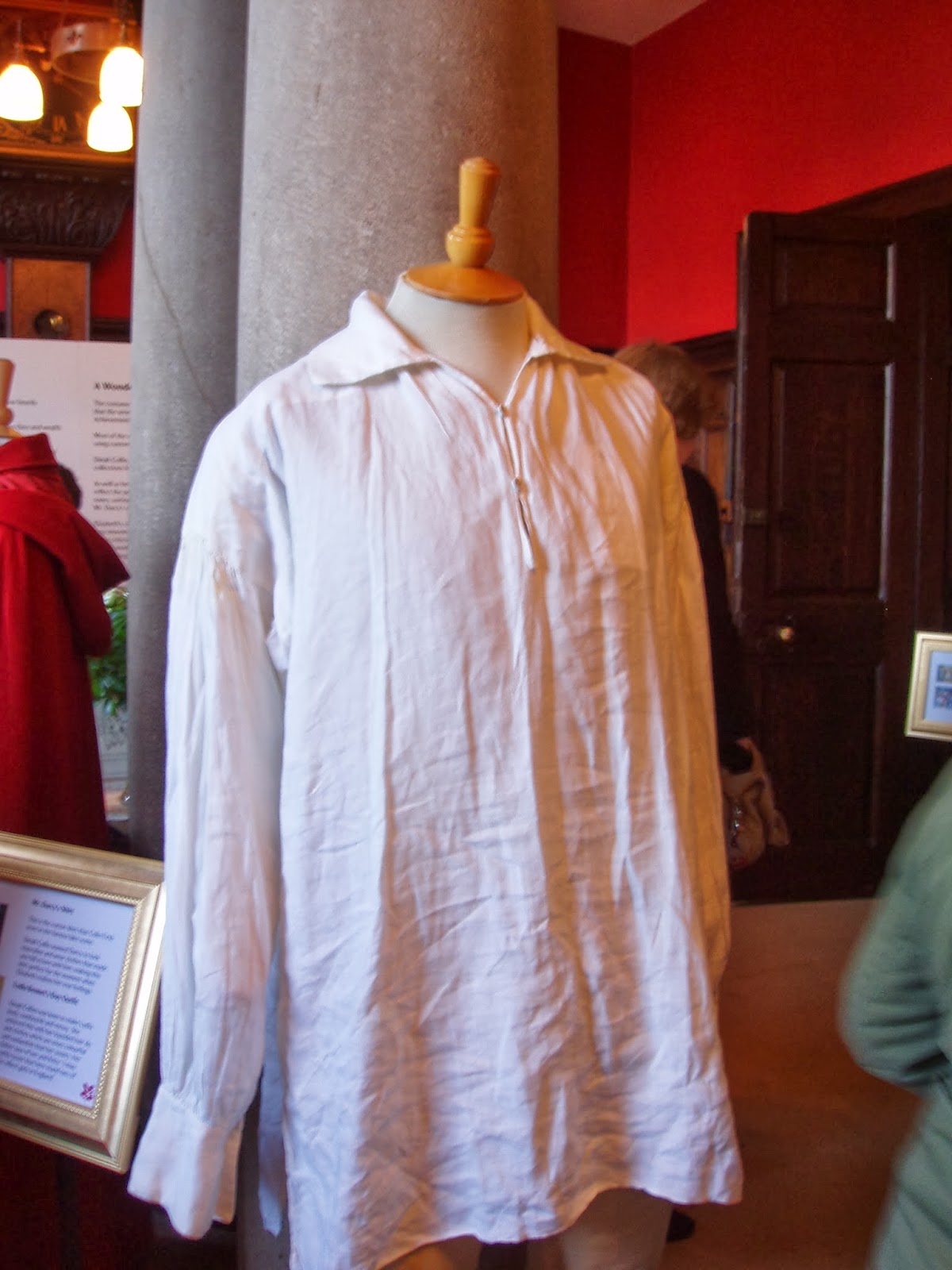
There was also a collection of the costumes worn during the filming of the BBC series.  Below are:
Lizzy and Mr Darcy's walking costumes


Lizzy and Mr Darcy's wedding costumes


and
That Shirt! 


Finally, we wandered round the grounds until we came to the lake, into which Mr Darcy (or rather Colin Firth) dived to cool off on that memorable day when Lizzy Bennet came calling.  And there he was, dripping wet and twelve feet tall.


Annie's next book is out in January.  "Courtship in the Regency Ballroom" contains reprints of two of her early stories: "His Cinderella Bride", and "Devilish Lord, Mysterious Miss."


Friday, 1 November 2013

Hallowe'en or Bonfire night? by Annie Burrows


 Novelista Annie Burrows writes historical romance for Harlequin Mills & Boon.  This month she delves into the history of Bonfire Night...
 
Last night my house was besieged by small children begging for sweets...all on the pretext of celebrating Hallowe'en.

In grumpy old woman mode, I huffed that this was just one more thing we've imported from America.  What about keeping up with British traditions, like Bonfire Night, for example?  Much more wholesome than celebrating ghouls and ghosts and mischief making.  I mean, trick or treat?  It's blackmail!  Fancy letting our children go round threatening to do something mean if we don't give them sweets!

Only...then I started to look up the origins of Bonfire Night which comes one week after Hallowe'en, on 5th November.

It started off as a lovely, patriotic sort of thanksgiving, didn't it?  Because the men who were conspiring to blow up the houses of Parliament, with all the Lords inside, were foiled...dramatically at the last minute.  The kegs of gunpowder were actually discovered in place, in the cellars, all primed and ready to go.
People lit bonfires round London, to celebrate the fact that King James I had survived the attempt on his life, and the next year, the day of celebration was made mandatory by Act of Parliament.

However, the more I read about the way the day was celebrated, the more my blood ran cold.  I'd forgotten the tradition of placing a "guy" on top of the bonfire.  Isn't burning someone in effigy just as ghoulish as anything that goes on at Hallowe'en?  In the past, the effigy on top of the bonfire didn't always represent Guy Fawkes either, but various other unpopular Roman Catholic figures, right up to, and especially, the Pope.  In early times, the day often turned into an expression of hatred for Catholicism in general - don't forget the names of our oldest and most traditional fireworks, the Roman Candle, and the Catherine Wheel.  (Because in the 4th Century, St Catherine of Alexandria was tortured on a wheel, hence the name for any rotating device which spits sparks and emits screams.)


Then again, there were the traditional rivalries between various gangs of youngsters building their own bonfires on patches of waste ground, often stealing their wood from rival's fires, and even getting into fights over it.
Ah, yes, the good old British tradition of the street fight...

And actually, now I come to think of it, children have always gone begging from door-to-door - only before the popularity of Hallowe'en, they asked for a "penny for the guy".  Everybody knew they were going to spend the money on sweets, or fireworks.  The law has tightened up now, but I can remember newspapers full of stories of children getting terribly disfigured playing with fireworks they'd bought and let off unsupervised. 

All in all, Hallowe'en is starting to look tamer and less unwholesome by the minute.  It's the children who dress up, rather than dressing effigies as unpopular public figures.  And they beg for sweets direct rather than the money to buy them.

And they may throw eggs, or squirt you with silly string, but far fewer people get their fingers blown off by playing with fireworks these days.


Annie's latest story "His Wicked Christmas Wager" is in an anthology called "A Scandalous Regency Christmas"
Available from Amazon UK

Thursday, 3 October 2013

Strictly Regency by Annie Burrows


Novelista Annie Burrows writes historical romance for Harlequin Mills & Boon.  This month she shares how a bout of research has been triggered by  Strictly Come Dancing!

I absolutely love the celebrity challenge show, Strictly Come Dancing, particularly because I'm a keen amateur ballroom dancer myself.  As this season's opening show ended with a beautiful, glamorous waltz, it set me wondering...just why was this dance considered so outrageous in Regency times?

Today, we think of the waltz as rather romantic, but a bit staid.  But when it first came to England, it even shocked the notorious Lord Byron.

So, I got searching...
During the Regency era, most of the dances were rather like our country dances.  If you've ever been to a barn dance, you would have been at home in a Regency ballroom.  People lined up to dance in sets of four or eight, and the figures performed would be shouted out by a caller.  Even though you would have a partner, you wouldn't be in any sort of hold with him, except for short bursts.
But the waltz was very, very different.


It began with the "March" which was a very brief side by side promenade.  This turned quickly into the "Pirouette."  The partners would take each other in one of several holds, one of the more popular of which had the partners facing in opposite directions, hip to hip, with one arm across the front of the partner's body and the other hands holding in an arch above the head.  In this hold, they would rotate very slowly, with their gaze fixed on one another.


The next was the "Sauteuse."  At this point, the dance got a bit more energetic, with dancers working a little hop into the step.  The hold would also change - one possible option would be the man holding both the lady's hands behind her back.


The routine would finish with the "Jetté", which was even more energetic.  But even so, the partners would be in bodily contact with each other the entire time.  And because the only floorcraft required was keeping one's place in a circle of others, all moving in slow progression round the room, there was no need for the man to take his eyes off his partner to watch where he was going.


And Lord Byron's objection?  The hands could rest on any number of body areas, and linger...

Let's face it, the Regency waltz was the equivalent of the slow smooch at the end of the disco...

Annie's latest story, in an anthology called "A Scandalous Regency Christmas" will be available from 8th October from Amazon UK

Friday, 6 September 2013

A writer's holiday... by Annie Burrows


Novelista Annie Burrows writes historical romance for Harlequin Mills & Boon.  This month she shares how research doesn't stop, even when she's on holiday...

One of the great things about being a writer of historical romance is that it gives me the perfect excuse to visit the many historical sites of England - under the guise of research.
 
But even when I go abroad on holiday, I can't resist poking around in museums to find out about the history of wherever I am.
 
This year I went to Madeira, and took a look behind the scenes at Blandy's wine merchants.  Not being in England, there were no scones, but I managed to tempt my husband onto the tour by pointing out we got a tasting session of the various wines at the end.

Our tour guide told us that John Blandy (whose life could serve as an example of how Regency men made their fortunes) was first posted to the island in 1807, as part of the British garrison which was guarding the island from Napoleon.  But there is also a letter to some wine merchants of the day, giving another explanation: 

‘Sirs! At the desire of our particular friend, Richard Fuller Esq., Banker in this City, we beg leave to introduce Mr John Blandy who visits your Island on account of ill health, and wishes to obtain employment in a Counting House. We shall be obliged if you can promote his views, and accordingly recommend him to your attention.’
The letter is dated 23 December 1807

Well, however the company started, Blandy's is now world famous as a producer of Madeira - which is a type of fortified wine.
 
The island of Madeira started supplying wine to the New World (or the United States as we like to call it nowadays) almost as soon as it was discovered.  But the voyage across the tropics sometimes caused the wine to "cook" in the barrels.  Although early customers complained this had spoiled the wine, and returned it, the suppliers realized that in fact it preserved it.  In its "cooked" state it would keep almost indefinitely.  Our tour guide told us that an opened bottle would last eighteen months.  (Not in our house it didn't!)  It soon became very popular in America, particularly in the hotter states where it was difficult to store wines in the cool conditions most of them require.  Madeira wine was the drink used to toast the Declaration of Independence.  George Washington apparently drank a pint of Madeira at dinner daily.  (Which made me feel less bad about getting through our souvenir bottle in less than a fortnight).
 
Nowadays the wine is not sent on a long voyage across the tropics to "cook" it.  Instead the process is done in the winery itself.  In fact the day we went round, they were pumping wine from the massive holding casks into the smaller oak barrels where it is naturally heated by the power of the sun.  The air smelled so rich and fruity it was like inhaling Christmas cake.
They've also made some changes to the process of making the wine.  The early growers of grapes used to be scattered all over the island.  They would each have their own press, and would send the juice down the mountainside in goatskins, carried on the backs of farm labourers.
 
 
When they set out, each goatskin would hold about 40 litres of juice...but there was often hardly anything like that on arrival as the thirsty labourers would drink it on the way down.
Hence the expression "having a skinful"
Nowadays, growers send grapes down the mountainside to be pressed at a central location.

(Annie's next book to be released in the UK is a short, spicy story in an anthology called "A Scandalous Regency Christmas"  For more details, visit Annie's website )